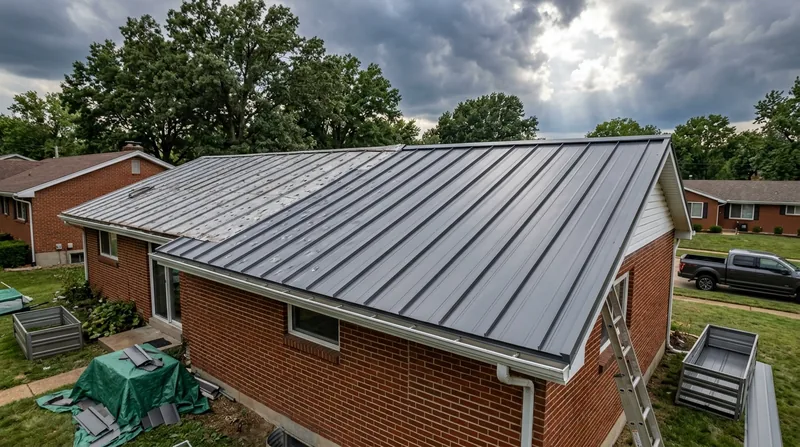




Storm & Wind Damage Repair in St. Louis
St. Louis sits where the Missouri River meets the Mississippi, on rolling bluffs and river bottoms that funnel spring hail, straight-line winds, and the occasional tornado right through neighborhoods from Soulard to Chesterfield. The 2011 Good Friday tornado and the May 2025 tornado through north city both peeled back roofing across whole blocks. If a fallen limb, hail dent, or wind-lifted panel has opened your metal roof, Storm & Wind Damage Repair in St. Louis starts with a free inspection and an honest call on repair versus replacement. We have worked these roofs since 2009, from slate mansard rowhouses in Lafayette Square to standing seam on 1990s two-story homes in Wildwood. Call (314) 689-1531 and we will get eyes on it fast.
Metal roofs take storm damage differently than shingles. A hail hit dents a panel or bruises the finish; wind works the fasteners and edge metal loose before it tears anything free. Knowing which one you are looking at decides whether you need a metal roof repair or a full panel replacement.
Why Storm Damage Hits St. Louis Metal Roofs So Hard
Our climate stacks the deck against roofing. Hot humid summers bake sealants and fastener washers, spring storms drop hail and 60 mph gusts, and winter brings ice storms followed by freeze-thaw cycles that work screws loose season after season. Add the mature oaks, sycamores, and pin oaks over South City bungalows and Kirkwood Tudors, and you get limbs on roofs every single spring. The failure mode that dominates here is wind-loosened fasteners and edge metal, not corrosion.
- Hail dents exposed-fastener panels and chips the coating on stone-coated steel, which opens the door to rust later.
- Wind lifts ridge caps and rake edges, then drives rain sideways under the panels.
- Fallen limbs crease standing seam panels and crush gutters, and the leak shows up weeks later at a seam.
- Ice dams at the eaves back water up under panels on north-facing slopes in St. Charles County.
Each of those needs a different fix, and guessing wrong means paying twice.
Key info: After the May 2025 tornado through north city, we found dozens of roofs in Florissant and Maryland Heights where the panels looked fine from the ground but the fasteners had backed out a quarter inch. A ground-level look misses that every time.
St. Louis City and County both publish roofing permit requirements, and inspection thresholds vary by jurisdiction. Check with the St. Louis City Building Division before any structural repair gets scheduled.
How We Handle Storm and Wind Damage, Step by Step
We do not send a salesperson with a clipboard. A roofer who has worked metal for years walks the roof, photographs every damaged area, and tells you what he sees. You get the photos whether you hire us or not, because that documentation is what your insurance adjuster needs.
- We inspect the full roof, not just the obvious damage, including fasteners, seams, flashing, and gutters.
- We photograph and measure every hit and log panel profile, gauge, and finish color for matching.
- We give you a written repair-versus-replace recommendation with the reasoning behind it.
- We prepare an itemized scope you can hand to your insurer and meet the adjuster on site if needed.
- We order matching panels and trim, then schedule the repair around weather windows.
- We test the repair with water before we call it done and clean the site.
If the damage is isolated, we repair. If panels are creased or the finish is shot across a whole slope, we tell you straight.
Key info: A homeowner in Webster Groves had a red oak limb punch through three standing seam panels. We matched the original 24-gauge panel and Kynar finish, replaced the three, and the roof reads as one continuous surface. No full replacement needed.
If wind has pulled screws across a whole slope, the fix is usually screw replacement and re-fastening with larger washered fasteners, not new panels.
Repair Approaches We Use on St. Louis Storm Damage
Not every storm hit calls for the same method. Here is how we match the approach to the damage.
| Approach | Description | Best for |
|---|---|---|
| Panel replacement | Cut out the damaged panel, install a matching profile and gauge, and reseal the seams. | Creased or punctured panels from fallen limbs |
| Re-fastening | Replace backed-out screws with larger washered fasteners and check torque across the slope. | Wind-loosened exposed-fastener roofs |
| Flashing and edge metal repair | Rebuild ridge caps, rake trim, and chimney or skylight flashing that wind has lifted. | Wind-driven rain leaks at edges and penetrations |
| Coating touch-up | Clean and recoat hail-bruised areas to stop rust from starting at the damage. | Cosmetic hail damage on painted or stone-coated panels |
| Full replacement | Tear off and reinstall when damage is widespread or the underlayment is compromised. | Tornado or widespread hail damage across multiple slopes |
We call the method after the inspection, not before it.
Storm & Wind Damage Repair Cost in St. Louis: What to Expect
Every storm job starts with a free inspection, because no honest number exists until someone has been on the roof. After that, cost tracks the scope: how many panels, how hard the access, how high the pitch. A single-panel repair with easy ladder access is a modest job. A limb through a steep turret roof on a Central West End mansion is not.
Three things move the price most: the number of panels and trim pieces involved, access and pitch, and whether matching material is still available. Older corrugated or ribbed profiles sometimes need a custom roll, and copper or specialty metal always costs more to match. Getting two or three estimates is smart, and compare scope line by line, not just the bottom line. Our full breakdown lives on the pricing page.
We document for insurance as a service, from inspection photos to the completed work. We never promise coverage, and we never suggest a deductible can be waived or absorbed.
Choosing a Storm & Wind Damage Repair Contractor Near Me in St. Louis
Storm season brings out-of-town crews with magnetic signs and cash-up-front pitches. A few checks separate the real contractors from the fly-by-nights. Ask for the Missouri contractor license and a certificate of insurance naming you, and verify the company has a local address. Ask for references from metal roof jobs, not just shingle work.
- Confirm the contractor is licensed and insured, and get the certificate before work starts.
- Get two or three written estimates and compare scope, not just price.
- Check references from jobs in your own neighborhood or a similar roof type.
- Ask who pulls the permit, because roofing permits are commonly required and thresholds vary by jurisdiction.
- Check historic district or HOA design review rules before ordering panels, since profile and color can be restricted.
We have been on St. Louis roofs since 2009 and are a Metal Roofing Alliance Member. Reach us through the contact page or call (314) 689-1531.
Storm & Wind Damage Repair in St. Louis: Pricing Guide
| Service | Price | Details |
|---|---|---|
| Roof inspection and damage report | Free | Full roof walk, photos of every hit, and a written repair-versus-replace recommendation |
| Single panel or isolated repair | Starting at $450 | Includes one matching panel, trim, sealant, and labor; pitch and access move the price |
| Multi-panel or slope-wide repair | Starting at $1,200 | Covers several panels plus re-fastening; panel count and material type drive the total |
| Wind re-fastening across a full roof | On estimate | Needs an on-site count of backed-out screws and a check of underlayment condition |
| Insurance documentation package | Included | Photo log, measurements, and itemized scope prepared for your adjuster at no extra charge |
| Estimate and travel | Free | In St. Louis and surrounding areas, response within 24 hours at (314) 689-1531 |
Indicative pricing, the exact cost depends on square footage, finish, and site access. Free personalized estimate within 24h at (314) 689-1531.


