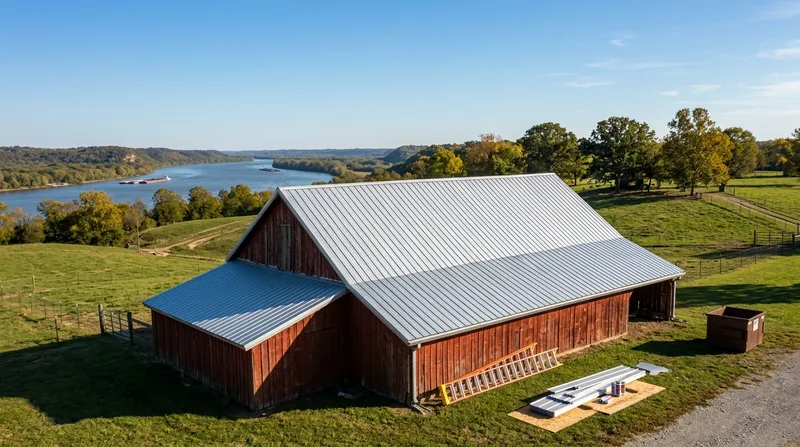




Commercial & Agricultural Metal Roofing in St. Louis
St. Louis sits where the Missouri River meets the Mississippi, and that geography shapes every roof in the region. From the red-brick warehouses near the riverfront to the barns and winery buildings out in Missouri River wine country around Augusta and Washington, metal roofs take a beating from hot humid summers, spring hail, and winter ice storms. If you manage a warehouse, church, light industrial building, or farm structure, Commercial & Agricultural Metal Roofing in St. Louis is the most durable way to protect your investment. We install, repair, and replace metal roof systems built for this climate, with panels and fasteners that hold up to freeze-thaw cycles and severe storm seasons. You get a roof that sheds water, resists wind uplift, and lasts decades longer than shingle systems on low-slope and high-volume buildings. Start with a metal roof installation consultation and we will walk your building and give you a straight answer on what it needs. Our crews have been working St. Louis roofs since 2009, and we are a Metal Roofing Alliance Member.
Why Commercial & Agricultural Metal Roofing Matters in St. Louis
St. Louis County and the surrounding region have a building stock that punishes weak roofs. Old brick industrial buildings near the riverfront have low-slope roofs that pond water. Barns and winery buildings out in the river bottoms face wind-driven rain and hail. Churches and warehouses in Florissant, Fenton, and Maryland Heights deal with the same spring storm systems that dropped the 2011 Good Friday tornado and the May 2025 tornado through north city. Metal roofing handles all of it better than asphalt on large footprints.
- Wind uplift resistance keeps panels locked down when straight-line winds and tornado warnings hit St. Louis County.
- Hail impact resistance protects the roof surface during the spring hail season that rolls through the Missouri River valley.
- Low-slope performance sheds water on flat and shallow-pitch commercial roofs where shingles fail fast.
- Long service life means fewer tear-offs and replacements on high-volume buildings over 30 to 50 years.
- Reflective finishes cut cooling costs during the hot humid summers that dominate June through September.
For a building owner, that combination means fewer emergency calls and a predictable maintenance budget.
Key info: A winery building near Washington, MO, with a low-slope roof over a tasting room and barrel storage needs a different panel and insulation package than a 20,000 sq ft warehouse in Fenton. We spec both from the same playbook: wind rating, drainage, and condensation control.
Roofing permits are commonly required for full replacements and re-roofs across St. Louis and St. Louis County. Thresholds, fees, and inspection requirements vary by jurisdiction, so always verify with the local building department. You can check the City of St. Louis building permit resources at stlouis-mo.gov before work starts.
How We Approach Commercial and Agricultural Metal Roofing in St. Louis
Every building gets a walk-through before we quote a number. We look at deck condition, existing layers, drainage, penetrations, and how the building is used. A church in Webster Groves with a steeple and skylights has different flashing and access needs than a pole barn in Jefferson County. We map the roof, document problem areas, and build a scope that matches the building, not a generic package.
- We inspect the roof deck, existing panels, fasteners, and flashing, and photograph the problem areas.
- We measure pitch, drainage paths, and penetration count to size the panel and insulation system.
- We recommend panel profile, gauge, coating, and fastener type based on wind and hail exposure.
- We pull the required permits through the local building department and coordinate inspections.
- We remove or recover the old roof per code, then install underlayment, panels, and closures.
- We finish flashing, ridge, and edge metal, then walk the roof with you and hand over documentation.
That process keeps surprises off the final invoice and keeps your building watertight through the next storm season.
Key info: On a Chesterfield light industrial building with two existing shingle layers, code limited us to a recover over one layer. We stripped to the deck, added a high-temp underlayment, and installed a standing seam panel with concealed fasteners. The owner got a 30-year roof without a second tear-off later. See our standing seam metal roofing page for that system.
Metal Roofing Systems We Install on Commercial and Agricultural Buildings
We match the system to the building, the budget, and the exposure. A hay barn in the river bottoms does not need the same roof as a church sanctuary in Kirkwood. Here are the approaches we use most on commercial and agricultural buildings across the region.
| Approach | Description | Best for |
|---|---|---|
| Standing seam panels | Concealed fasteners, raised seams, long panel runs with fewer penetrations. | Warehouses, churches, and light industrial buildings that need maximum weather tightness. |
| Exposed-fastener ribbed panels | Screw-down corrugated or ribbed steel with a proven cost-to-performance ratio. | Barns, machine sheds, and agricultural buildings where budget drives the decision. |
| Insulated metal panels | Factory-foam core panels that combine roof deck and insulation in one pass. | Cold storage, winery barrel rooms, and buildings that need condensation control. |
| Retrofit over existing roof | New metal panels installed over the existing roof where code allows. | Commercial buildings that want to avoid a full tear-off and interior disruption. |
| Repair and re-fastening | Screw replacement, sealant renewal, and panel patching on existing metal roofs. | Older agricultural and commercial roofs with loose fasteners or failing seals. |
Each system has a place, and we will tell you which one fits your building instead of selling you the most expensive option.
Commercial & Agricultural Metal Roofing Cost in St. Louis: What to Expect
Pricing on commercial and agricultural metal roofs depends on square footage, roof pitch, deck condition, panel type, insulation, and access. A simple barn roof in Arnold prices very differently from a multi-level warehouse in Maryland Heights with HVAC curbs and skylights. We start every project with a free estimate, and the number you get reflects the actual scope, not a per-square-foot guess. As a realistic starting point, small agricultural repairs often land in the low four figures, while full commercial replacements run into five figures and up depending on size and system.
Factors that move the price include the number of existing layers to remove, the panel gauge and coating you choose, insulation R-value, the number of penetrations and flashing details, and how tight the site is for equipment access. Hail and storm damage repairs can also shift cost depending on what the inspection finds under the panels. Getting two or three estimates is smart because it lets you compare scope, not just the bottom line. Our full pricing overview breaks down what drives those numbers.
Commercial & Agricultural Metal Roofing Near Me: How to Vet a Contractor Near St. Louis
Hiring the wrong crew on a commercial roof costs more than the job. You want a contractor who knows St. Louis building departments, understands historic district and HOA design review on older commercial buildings, and can show you completed metal roofs on similar structures. Ask questions before you sign anything, and do not let urgency push you past the basics.
- Confirm the contractor is licensed and insured, and ask for a certificate of insurance before work begins.
- Get at least two or three written estimates so you can compare scope line by line.
- Ask for references on commercial or agricultural metal roofs completed in the last two years.
- Verify who pulls the permit and who handles inspections with the local building department.
- Check whether historic district or HOA design review restricts panel profile or color on your building.
- Ask how the contractor handles change orders and what happens if deck damage is found mid-project.
A contractor who answers those questions clearly is a contractor who will finish the job cleanly. When you are ready to talk scope and schedule, contact us and we will set up a walk-through at your building.
Key info: The May 2025 tornado through north city and the 2011 Good Friday tornado both left commercial roofs with lifted panels and torn fasteners. After a storm, get an inspection before you authorize repairs. We document damage for insurance purposes, but coverage decisions stay with your carrier.
From the riverfront warehouses to the winery buildings around Augusta and Washington, we build metal roofs that hold up to St. Louis weather. Call St. Louis Metal Roofing at (314) 689-1531 to schedule a free estimate on your commercial or agricultural building.
Commercial & Agricultural Metal Roofing in St. Louis: Pricing Guide
| Service | Price | Details |
|---|---|---|
| Roof inspection and written scope | Free estimate | Full roof walk, photos of problem areas, and a written scope before any number is quoted. |
| Agricultural repair or re-fastening | Starting at $1,500 | Screw replacement, sealant renewal, and panel patching on barns and sheds; size and access drive the price. |
| Exposed-fastener ribbed panel install | Starting at $6 per sq ft | Screw-down steel over new or prepared deck; gauge, insulation, and penetration count move the number. |
| Standing seam commercial replacement | On estimate | Concealed-fastener system on warehouses and churches; pitch, deck condition, and HVAC curbs need an on-site look. |
| Travel | Included | In St. Louis and surrounding counties, no separate call-out or mileage fee for estimates. |
| Estimate | Free | Response within 24 hours at (314) 689-1531, no obligation to book the work. |
Indicative pricing, the exact cost depends on square footage, finish, and site access. Free personalized estimate within 24h at (314) 689-1531.


