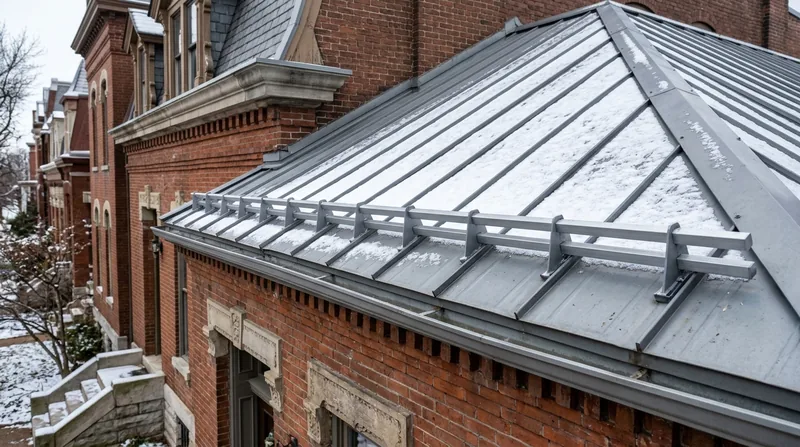




Snow Guards & Ice Protection in St. Louis: Stop the Slide Before It Hits the Walk
St. Louis sits where the Missouri River meets the Mississippi, on rolling bluffs and river bottoms that get hot, humid summers and then winter ice storms that coat every standing seam and mansard in sight. If your home has a Snow Guards & Ice Protection in St. Louis setup that was never installed, or was installed for a different panel profile, you already know the problem: a sheet of snow releases all at once and lands on the entry steps, the sidewalk, or the parked car. We install pad-style snow guards, bar and rail systems, and ice barrier detailing built for the steep roofs and mansards common on Lafayette Square rowhouses, Central West End brick mansions, and the 1910s-1930s bungalows and Tudors across South City and Webster Groves. Our crews have worked St. Louis County roofs since 2009, and we hold a Metal Roofing Alliance membership. If you want the broader picture on how these parts fit a metal roof, start with our standing seam metal roofing page and then come back here for the snow side of it.
Why Snow Guards Matter on St. Louis Metal Roofs and Mansards
St. Louis winters are not Minnesota winters, but they are freeze-thaw winters. A 34-degree day melts the top of the pack, the next night drops to 18, and you get a hard ice layer bonded to a slick metal panel. On a steep mansard in Soulard or a 9/12 standing seam in Kirkwood, that pack releases as a single slab. The failure mode that dominates here is sliding snow and ice, not heavy accumulation. Snow guards hold the pack in place so it melts and drains in a controlled way instead of launching off the eave.
- They protect people on the sidewalk, the mail carrier, the Amazon driver, and the kids waiting for the school bus.
- They protect the gutter, the downspout, and the landscaping beds that sit directly under the drip line.
- They protect lower roof sections, porch roofs, and the car parked in the drive.
- They reduce the sudden load on seams and fasteners that causes metal roof leak repair calls every February.
On a steep roof, a properly spaced guard layout is the difference between a controlled melt and a 200-pound ice slab on your front steps.
Key info: A Lafayette Square rowhouse with a slate mansard and a metal replacement cap needs guards spaced tighter than a low-slope Chesterfield ranch. The pitch drives the layout, not the square footage.
For the code side of roof work in the city, the City of St. Louis Building Division publishes permit and inspection guidance at stlouis-mo.gov. Rules vary by jurisdiction, so always confirm with your local building department.
How We Install Snow Guards and Ice Protection on a St. Louis Roof
We do not sell a box of guards and call it a day. We look at the panel, the pitch, the eave height, and what sits below the drip line. A Webster Groves Tudor with a steep front gable over the front walk gets a different layout than a North County brick ranch with a low-slope porch. We measure, mark, and set the pattern before we drill a single hole.
- We inspect the roof and confirm the panel type, seam spacing, and fastener condition.
- We map the slide zones: entries, walkways, driveways, HVAC units, and lower roof planes.
- We select the guard type (pad, bar, or rail) and calculate row spacing for the actual pitch.
- We set guards on the seam or pan with the correct clamp or fastener and sealant for that metal.
- We check the ice barrier and eave detailing so meltwater has a path to the gutter.
- We walk the roof with you and mark the layout so you can see the coverage before we leave.
Every layout is documented, so the next contractor who touches the roof knows what is there.
Key info: On a steep copper or standing seam roof in the Central West End, we clamp guards to the seam rather than penetrate the panel. That keeps the metal watertight and preserves the finish. See our copper and specialty metal work for how we handle those profiles.
Snow Guard and Ice Protection Approaches We Use
There is no single right guard for every St. Louis roof. The panel profile, the pitch, and the look of the house all matter, and historic districts and HOAs can restrict what you can see from the street. Here is how the main approaches compare.
| Approach | Description | Best for |
|---|---|---|
| Pad-style snow guards | Individual pads set in rows across the panel to break up the pack. | Standing seam and metal shingle roofs on homes where a low profile matters. |
| Bar and rail systems | Continuous rails mounted above the eave to hold the full snowpack. | Steep mansards and high-slope roofs over entries and walkways. |
| Seam-clamp guards | Clamps that grip the standing seam without piercing the panel. | Copper and painted standing seam where finish and watertightness matter. |
| Ice barrier and eave detailing | Underlayment and edge metal that manage meltwater at the eave. | Freeze-thaw winters and roofs with a history of ice damming. |
| Exposed-fastener guard layouts | Guards set to the rib pattern on corrugated and ribbed panels. | Barns, winery buildings, and ag roofs around Augusta and Washington. |
We pick the approach that fits the panel and the pitch, not the one that is easiest to stock.
Snow Guards & Ice Protection Cost in St. Louis: What to Expect
Most residential snow guard jobs in St. Louis start around $1,200, and that figure covers a typical single-family roof with guards on the main slide zones. The number moves with roof pitch, eave height, panel type, and how many rows the layout needs. A steep mansard over a front entry in Soulard takes more guards per foot than a low-slope ranch in Florissant. Copper and specialty metal takes seam clamps and more time. Access matters too: a tight lot with a fence and a steep drop costs more to work than an open backyard.
We give you a written scope with the guard type, row spacing, and coverage map so you can compare bids line for line. Get two or three estimates and ask each contractor what happens at the eave and how they handle the ice barrier. The full pricing overview shows how guard work fits with the rest of a metal roof project.
Snow Guards & Ice Protection Near Me: How to Vet a Metal Roofing Contractor Near St. Louis
Snow guard work looks simple until a guard pulls out of a seam or a bad clamp leaks. Ask for proof of licensing and insurance, and get a certificate of insurance before anyone gets on the roof. Ask for references from jobs with the same panel profile as yours, not just the same zip code. In historic districts and HOA neighborhoods, confirm who handles design review before you sign, because panel and guard color can be restricted. And confirm the contractor pulls the permit where one is required for the roof work.
We are happy to walk you through our scope and our coverage. Reach us through the contact and free estimate page, or call (314) 689-1531. We serve St. Louis and the surrounding county, and we will tell you straight if guards are the right call for your roof or if the real problem is a fastener or flashing issue that needs metal roof repair first.
Snow Guards & Ice Protection in St. Louis: Pricing Guide
| Service | Price | Details |
|---|---|---|
| Pad-style snow guards, single-family roof | Starting at $1,200 | Covers guard layout and install on main slide zones; pitch and row count move the price. |
| Bar and rail system over entries | Starting at $2,100 | Continuous rail above walkways and entries; eave height and access drive the number. |
| Seam-clamp guards on copper or standing seam | Starting at $1,800 | Non-penetrating clamps matched to the seam; specialty metal and finish add time. |
| Ice barrier and eave detailing | Starting at $950 | Underlayment and edge metal to manage meltwater; roof access and tear-off affect cost. |
| Complex or large-scale job | On estimate | Steep mansards, multiple roof planes, and historic review need an on-site look first. |
| Estimate | Free | Response within 24h at (314) 689-1531, no obligation to book the work. |
Indicative pricing, the exact cost depends on square footage, finish, and site access. Free personalized estimate within 24h at (314) 689-1531.


