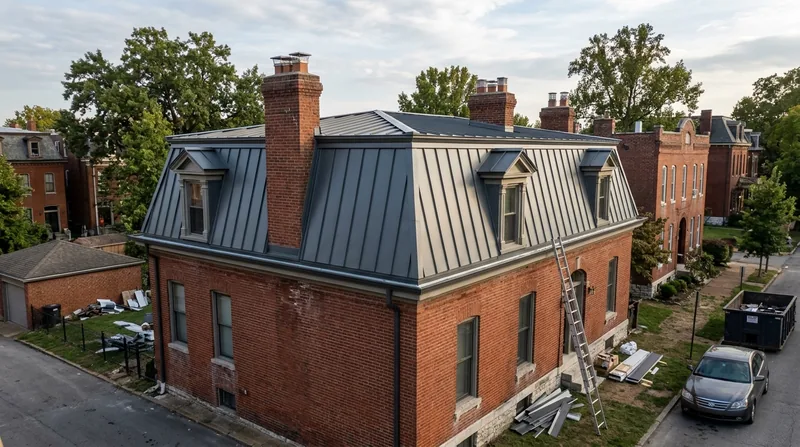




St. Louis sits where the Missouri River meets the Mississippi, and that geography shapes every roof we work on. From the slate mansards of Lafayette Square and Soulard to the brick bungalows of South City and the newer two-story homes out in Chesterfield, homeowners here face hot humid summers, spring hail, and winter ice storms that punish a roof. If you are considering Standing Seam Metal Roofing in St. Louis, you are looking at the concealed-fastener system that holds up best against that cycle. Panels are roll-formed to length and mechanically seamed, so there are no exposed screws to back out and no fastener washers to dry-rot. We have installed these systems since 2009 across the city and county, and we roll-form on site to fit each roof exactly. If you are weighing this against a full metal roof installation, start here and we will tell you straight whether standing seam is the right call for your house.
Why Standing Seam Holds Up to St. Louis Weather and St. Louis Roofs
St. Louis gets the full range: humid summers that cook asphalt shingles, spring hail that cracks them, and freeze-thaw cycles in January that work ice under every seam. Standing seam handles all three because the fasteners are hidden under the panel and the seams are folded tight by machine. On the steep mansards and turrets of the Central West End and the historic districts, that clean profile also passes design review far more easily than an exposed-screw panel.
- Concealed fasteners eliminate the screw back-out and washer failure that dominate leak calls on exposed-fastener roofs.
- Class 4 impact options resist the spring hail that rolls through St. Louis County most years.
- High wind ratings matter on the bluffs and open lots where the May 2025 tornado track proved how much uplift these roofs take.
- Long panel runs mean fewer seams, and fewer seams mean fewer places for water to find a way in.
- Clean sight lines suit the brick bungalows, Tudors, and historic rowhouses that define so much of the city.
For a city with this much historic brick and this much severe weather, standing seam is the system that solves both problems at once.
Key info: In Lafayette Square and Soulard, the slate mansards on 1860s to 1910s rowhouses are often past their service life. A standing seam panel in a matching color gives you the same crisp look with a fraction of the maintenance, and it clears historic design review when we match the profile and color to the district.
Before you commit to a panel profile or color, check the permit and design rules for your address with the City of St. Louis Building Division, since thresholds and historic review vary by jurisdiction.
How We Install Standing Seam on a St. Louis Roof
Every job starts with a real inspection, not a sales pitch. We get on the roof, check the deck, measure the panel runs, and look at how the existing flashing ties into chimneys and skylights. Then we roll-form the panels to length on site so each run fits your roof without a splice in the middle of a slope. The mechanical seamer folds every seam tight, and we walk the whole roof before we call it done.
- We inspect the deck and framing and replace any soft sheathing before a single panel goes up.
- We install underlayment and new flashing at chimneys, skylights, and valleys so water has nowhere to sit.
- We roll-form panels to length on site and set them with concealed clips that allow for thermal movement.
- We mechanically seam every panel and seal the terminations at the ridge, eave, and gables.
- We clean the site, walk the roof with you, and hand over the warranty paperwork.
That sequence is why our standing seam roofs stay tight through a decade of St. Louis freeze-thaw.
Key info: On a 1920s brick Tudor in Webster Groves, the original roof had three separate penetrations and a chimney that leaked every spring. We re-flashed the chimney, rolled panels long enough to clear the dormers, and the homeowner has not had a leak call since. That is the kind of detail work standing seam rewards.
If your roof ties into complex flashings or you are weighing options, our Webster Groves standing seam page walks through how we handle those older brick homes.
Standing Seam Approaches We Use Across St. Louis
Not every St. Louis roof wants the same panel. A steep historic mansard, a low-slope porch roof, and a wide ranch roof in South County each call for a different profile and seam height. Here is how we match the approach to the building.
| Approach | Description | Best for |
|---|---|---|
| Snap-lock standing seam | Concealed clip system with a snap-together seam for faster installs. | Pitched roofs on post-war ranches and newer Chesterfield homes. |
| Mechanically seamed panels | Seams folded by a powered seamer for maximum wind and water resistance. | Exposed bluffs, open lots, and homes in tornado-prone corridors. |
| Class 4 impact panels | Heavier gauge and impact-rated finishes for hail country. | St. Louis County homes hit by spring hail most years. |
| Historic-profile panels | Narrower seam spacing and period colors to match old mansards. | Lafayette Square, Soulard, and Central West End historic homes. |
| Low-slope standing seam | Taller seam and tighter spacing for porch and addition roofs. | Porches and additions on older brick homes across the city. |
We pick the panel for your roof and your weather exposure, not the other way around.
Standing Seam Metal Roofing Cost in St. Louis: What to Expect
Homeowners ask us for a standing seam price every week, and the honest answer is that it depends on the roof. As a starting point, expect From $10 per square foot for a standard standing seam install, and plan on more for steep mansards, complex flashings, or Class 4 impact panels. Roof pitch, panel length, tear-off of the old roof, and how many penetrations we have to work around all move the number. Historic districts can add design review time, and a steep turret in the Central West End takes more labor than a simple gable in Ballwin.
Get two or three written estimates and compare what is actually included: underlayment, flashing, tear-off, and warranty. A low number that skips the flashing is not a deal. Our full pricing overview breaks down the ranges so you can compare apples to apples.
Standing Seam Metal Roofing Near Me: How to Vet a Contractor Near St. Louis
When you search for standing seam metal roofing near me, you will get a long list, and not all of them belong on your roof. Ask for proof of licensing and insurance before anyone climbs a ladder, and get the certificate sent to you directly. Call two or three references from jobs in St. Louis County and ask how the roof has held up through hail and ice. Confirm who pulls the permit and whether your address sits in a historic district or under an HOA design review. A contractor who hesitates on any of those questions is telling you something.
We are a Metal Roofing Alliance member, in business since 2009, and we will hand you our insurance certificate without being asked. Reach out through our contact page and we will set up a free inspection and estimate.
Standing Seam Metal Roofing in St. Louis: Pricing Guide
| Service | Price | Details |
|---|---|---|
| Standard standing seam install | Starting at $10/sq ft | Includes underlayment, concealed clips, and mechanically seamed panels on a standard pitched roof. |
| Class 4 impact panels | Starting at $13/sq ft | Hail-rated heavier gauge for St. Louis County homes, priced above standard panels. |
| Historic-profile install | Starting at $15/sq ft | Narrower seam spacing and period colors for mansards and historic district homes. |
| Complex or steep roof | On estimate | Turrets, multiple penetrations, and steep pitches need an on-site look before we quote. |
| Travel | Included | in St. Louis and surrounding areas, no separate call-out or mileage fee. |
| Estimate | Free | Response within 24h at (314) 689-1531, no obligation to book. |
Indicative pricing, the exact cost depends on square footage, finish, and site access. Free personalized estimate within 24h at (314) 689-1531.


