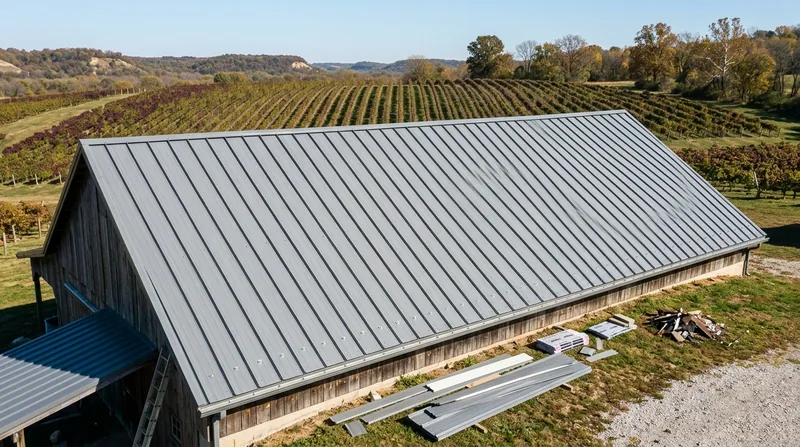




Corrugated & Ribbed Panel Roofing in St. Louis
St. Louis sits where the Missouri River meets the Mississippi, with rolling bluffs, river bottoms, and a building stock that runs from 1860s red-brick rowhouses in Soulard to 1990s two-story homes in Chesterfield. Exposed-fastener metal roofing is the workhorse across that whole spread, and Corrugated & Ribbed Panel Roofing in St. Louis is what we install on barns, garages, carriage houses, workshops, and ag buildings from Augusta wine country to the Jefferson County line. These panels shed spring hail and summer downpours, and they handle the freeze-thaw cycles that chew up asphalt shingles in North County and South County. If you need a roof that goes on fast, takes a hit, and stays put, this is the profile. Compare it against our standing seam metal roofing when you want hidden fasteners, but for outbuildings and budget-conscious re-roofs, exposed fastener is hard to beat.
Why Exposed-Fastener Panel Roofing Makes Sense on St. Louis Outbuildings
St. Louis weather hits roofs from three directions: spring hail out of the southwest, summer wind and tornadoes like the 2011 Good Friday storm and the May 2025 north city tornado, and winter ice storms that load up eaves and gutters. Corrugated and ribbed panels are through-fastened with screws and neoprene washers, so they flex under hail impact instead of cracking like shingle mat, and the ribs stiffen the panel against uplift. On the brick bungalows and Tudors of South City and Webster Groves, these panels go over existing decking or purlins with proper closures, and on farm shops in St. Charles County they span open purlins with no sheathing at all.
- They handle hail impact better than three-tab or architectural shingles because the steel dents rather than fractures.
- They shed ice dams and snow load faster on the low-slope porch and garage roofs common in Kirkwood and University City.
- They go down fast, which keeps labor hours and dumpster costs lower than a tear-off and shingle re-roof.
- They come in a full color range, so a barn in Wildwood or a carriage house in Lafayette Square can match the historic palette.
- They last decades with only screw and washer replacement as the main wear item.
Before any panel order, verify permit and inspection requirements with the City of St. Louis Building Division, since thresholds and fees vary by jurisdiction and historic districts may restrict profile and color.
Key info: A barn roof outside Washington, MO in Franklin County takes a different screw pattern and closure set than a garage roof in Florissant. Wind exposure, purlin spacing, and panel gauge all change the spec, so we measure on site before quoting.
How We Install Corrugated & Ribbed Panels Across St. Louis County
We start with a walk of the roof and a look at the deck or purlins, because a 40-year-old carriage house in Soulard may have skip sheathing that needs furring before panels go down. From there we set the screw pattern to the local wind zone, cut panels to length on site to avoid end laps, and install closures at eaves, ridges, and gable ends. Every penetration gets a proper boot or flashing, not a smear of sealant. You can see how that ties into our flashing, chimney and skylight repair work when a chimney or vent stack interrupts the panel run.
- We measure the roof, check deck condition, and confirm purlin spacing or sheathing thickness.
- We order panels cut to the longest practical length to eliminate horizontal laps that leak.
- We install eave trim, then lay panels square to the ridge and fasten on the high rib per the wind zone.
- We set closures at the ridge, gable, and eave, and flash every pipe, chimney, and skylight.
- We walk the roof for screw torque and washer seal, then clean the gutters and magnet-sweep the yard.
The order matters: panels go on square and fasteners go in straight, or the whole roof telegraphs the mistake for the next 30 years.
Key info: On a 30x40 shop in Fenton with open purlins, we ran 5V panels with a 24-inch screw pattern on the perimeter and 36-inch in the field, matched to the exposure. The owner wanted a red barn look, and the color came from a standard panel line, not a custom order.
Panel Profiles and Fastening Approaches: What Fits Your Building
Not every exposed-fastener job is the same. Corrugated, R-panel, and 5V each solve a different problem, and the right choice depends on slope, span, and whether the building is historic or agricultural. Here is how we sort them on St. Louis area jobs.
| Approach | Description | Best for |
|---|---|---|
| Corrugated panels | Wavy profile, 2.5-inch or 0.75-inch pitch, through-fastened with screws and washers. | Barns, sheds, and outbuildings where cost and classic look matter. |
| R-panel (ribbed) | Square rib profile with a flat pan, 36-inch coverage, exposed fasteners on the high rib. | Garages, workshops, and commercial shops that want a cleaner line. |
| 5V crimp | Classic 5-rib profile, often used on historic and agricultural buildings. | Carriage houses, winery buildings, and older St. Louis County structures. |
| Over-purlin install | Panels fastened directly to open purlins with no sheathing, common on ag buildings. | Pole barns and machine sheds in St. Charles and Jefferson County. |
| Over-deck install | Panels over existing sheathing or furring, with underlayment where required. | Garages and additions tied to a house roof in Chesterfield or Ballwin. |
We spec the profile after we see the structure, because span and slope rule out some options before color ever comes up.
Corrugated & Ribbed Panel Roofing Cost in St. Louis: What to Expect
Pricing for exposed-fastener metal starts at From $5.50 per square foot installed, and that figure covers panels, fasteners, closures, standard trim, and labor on a straightforward roof. The number moves with panel gauge, roof height and pitch, tear-off of old shingles, deck repairs, and how many penetrations need flashing. A simple garage roof in Affton lands near the low end; a steep barn roof in Washington with two chimneys and a cupola sits higher. Get two or three estimates and compare the scope line by line, because a low bid that skips underlayment or closures is not the same job. Our full pricing overview breaks down what each line item covers.
What to Look for in a Metal Roofing Contractor Near Me in St. Louis
Hiring for corrugated or ribbed panel work is mostly about verifying the basics and reading the scope. Ask for the Missouri contractor license and a certificate of insurance that names general liability and workers comp, then call the number on the certificate to confirm it is current. Get at least two estimates in writing with panel gauge, screw type, closure locations, and tear-off included or excluded. Ask for references on jobs similar to yours, meaning outbuildings or low-slope roofs, not just house re-roofs. Confirm who pulls the permit, since St. Louis County and the City of St. Louis both require one for most re-roofs and inspect the work. If you are in a historic district like Soulard or Lafayette Square, check design review rules on panel profile and color before you sign. Reach out through our contact and free estimate page when you are ready to compare scope.
We have been installing metal roofing in the St. Louis area since 2009 and are a Metal Roofing Alliance member. Call (314) 689-1531 to set up a look at your building.
Corrugated & Ribbed Panel Roofing in St. Louis: Pricing Guide
| Service | Price | Details |
|---|---|---|
| Corrugated panel roof, simple outbuilding | Starting at $5.50/sq ft | Includes panels, screws, closures, standard trim, and labor on an accessible single-slope roof. |
| R-panel or 5V roof, house-attached garage | Starting at $6.75/sq ft | Adds underlayment, edge metal, and flashing tie-ins where the roof meets the house wall. |
| Tear-off of existing shingles before panel install | Starting at $1.50/sq ft | Covers removal, dumpster, and disposal, with deck inspection and minor repairs as needed. |
| Steep, tall, or cut-up roof (barn, cupola, multiple penetrations) | On estimate | Pitch, height, and penetration count drive the labor, so we measure before quoting a number. |
| Travel | Included | In St. Louis and surrounding counties, no separate call-out or mileage fee. |
| Estimate | Free | Response within 24 hours at (314) 689-1531, no obligation to book the work. |
Indicative pricing, the exact cost depends on square footage, finish, and site access. Free personalized estimate within 24h at (314) 689-1531.


